
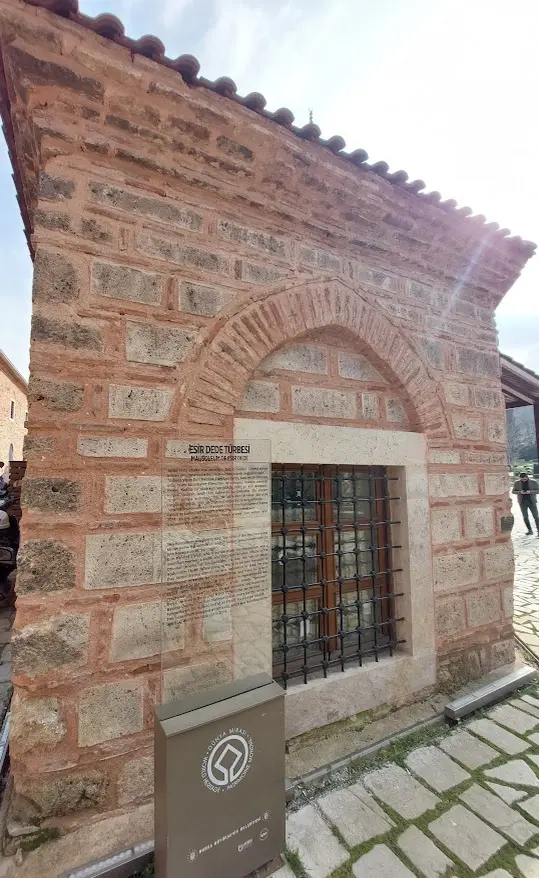
In the heart of Bursa’s historic streets, right behind the Silk Bazaar (İpek Han) and next to the Sağrıcı Sungur Masjid, lies a modest site with a legendary story: The Tomb of Esir Dede.
While local lore knows him as “Esir Dede” (The Captive Grandfather), this was actually the final resting place of Esiri Mehmed Efendi, a scholar who rose to the highest religious office in the Ottoman Empire—the Sheikh ul-Islam—following a life defined by adventure, captivity, and exile.
From Captivity to the Peak of Scholarship
Originally from İbradı, Mehmed Efendi completed his education in Istanbul and served in prestigious roles as a professor (müderris) and judge (kadı). However, the year 1644 marked a dramatic turning point in his life. While sailing to Egypt for his appointment as the Judge of Mecca, his ship was intercepted off the coast of Rhodes by the Knights of Malta.
In the bloody skirmish that followed, his companion Sünbül Ağa was killed, and Mehmed Efendi was taken captive. He spent four years in slavery before being ransomed and returning to Istanbul. From that day forward, he was known by the epithet “Esiri” (The Captive).
Political Turmoil and Exile to Bursa
Rising through the ranks despite his past hardships, Esiri Mehmed Efendi was appointed Sheikh ul-Islam in 1659. His tenure coincided with one of the most turbulent eras of the Empire. His downfall came after a disagreement with the powerful Grand Vizier Köprülü Fazıl Ahmed Paşa. His criticism of the administration’s harsh methods led to his dismissal and subsequent exile—first to Gallipoli, then back to Rhodes, and finally to Bursa.
Legacy in Bursa: The Esir Dede Tomb
Esiri Mehmed Efendi spent the last 20 years of his life in Bursa, dedicating himself to charity and restoration. He personally oversaw the revitalization of the area where his tomb now stands.
- Construction: The tomb was built by Mehmed Efendi himself in 1680, just one year before his passing.
- Architecture: It is a classic Ottoman structure with a rectangular plan, featuring stone and brick masonry walls and a timber-roofed top. The large pointed arch at the northern entrance is its most striking feature.
- The Name “Esir Dede”: The tomb was originally associated with the Sağrıcı Sungur (or Sarıca Sungur) neighborhood. However, the scholar’s fame and his nickname “Esiri” eventually transformed in the local dialect to “Esir Dede,” which remains its official name today.
- Who Rests Here: Alongside Esiri Mehmed Efendi, the tomb houses the graves of his mother, Fatma Hanım, and his brother, Ali Efendi.